Every pole dancer knows the feeling. Tuesday you nailed that pole sit. Thursday you slid straight down the same pole. Nothing is wrong with your technique. Grip changes from day to day, and it’s one of the most talked-about topics in any pole changing room.
Your skin: too dry or too sweaty
Grip comes from a little moisture and friction between skin and metal. Pole dancers tend to fall into two camps:
- Dry skin has too little moisture to grip, so it feels slippery. It’s common in cold weather and air-conditioned rooms.
- Sweaty skin has too much moisture. The pole gets slick, especially later in class.
That’s why grip advice that works wonders for one person does nothing for another. Work out which camp you’re in first.
The weather really does matter
Humidity and temperature change both your skin and the pole. Hot, humid days make most people sweatier and poles slicker. Cold days dry skin out and leave metal poles cold and slippery until they warm up. It’s why the same class can feel completely different in July and January.
The pole itself
Pole finishes grip differently:
| Finish | What people say |
|---|---|
| Chrome | The classic finish. Smooth and fast, and a bit slippery for sweaty hands. |
| Stainless steel | Common in studios. Durable, with grip similar to chrome. |
| Brass | Often grippier, and a favorite with sweaty-skinned dancers. |
| Powder-coated & silicone | Very grippy. Great for holds, but less forgiving on skin when sliding or spinning. |
Diameter matters too. Many studios use 45 mm poles, while smaller diameters are easier for smaller hands to wrap around.
Grip aids
Grip aids generally fall into two families, matching the two skin camps:
- Drying aids (often liquid chalk-style) for sweaty skin.
- Tacky aids for dry skin, adding a little stickiness.
Always check your studio’s rules first. Some studios limit certain products because they build up on poles and affect the next class.
Tips for students
- Skip lotion on pole days, especially on legs and arms.
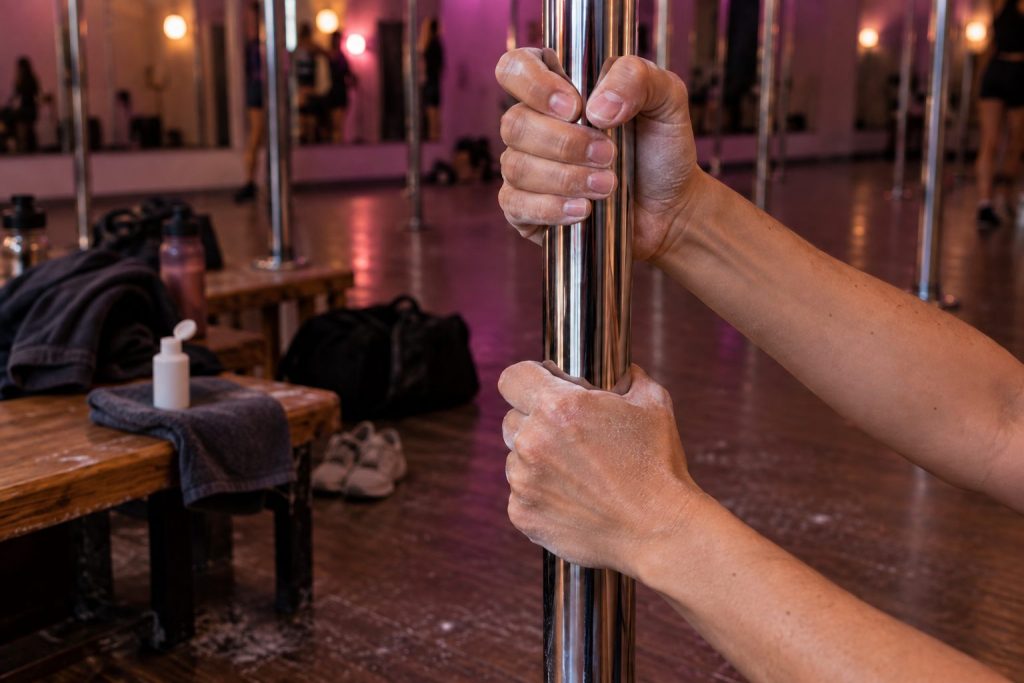
- Clean your hands and the pole before you start.
- Warm up the pole by using it, since cold metal is slippery.
- Wear shorts. Many holds need skin contact to grip, which is why pole outfits look the way they do.
- Be patient. Grip improves with strength and technique over time.
Tips for studios
- Clean poles between classes so the next group starts fresh.
- Watch the climate. A dehumidifier in summer and heating in winter make a real difference.
- Tell students before they arrive. A “no lotion today” line in booking confirmations saves a lot of slipping.
- Stock grip aids at the front desk. Students need them, and it’s easy retail.