“Aerial” covers a whole family of apparatus, and each one feels different in the hands, the body and the nerves. Here’s a quick tour for curious students, and for studio owners deciding what to offer next.
Aerial silks (tissu)
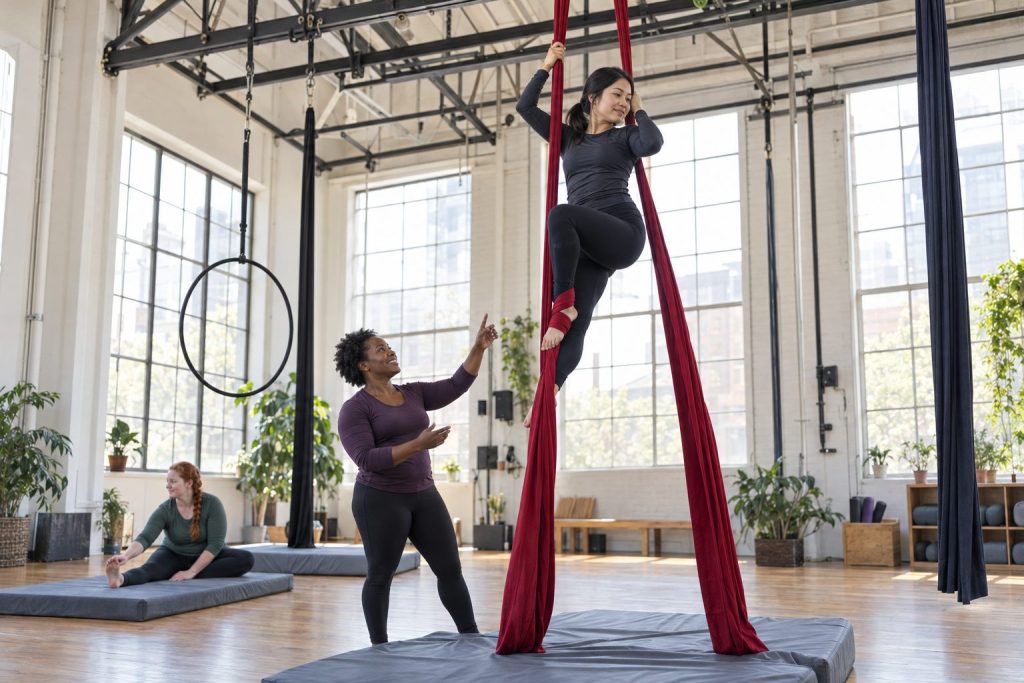
Two long lengths of stretchy fabric hang from a single rigging point. Students climb, wrap themselves in the fabric, hold poses and, at advanced levels, unroll into dramatic drops.
- Feels like: a full-body workout for grip, arms and core, with a lot of problem-solving about which wrap goes where.
- Suits: patient learners who enjoy sequences. Climbing takes practice at first.
- How it’s taught: climbs and foot locks, then inversions and wraps, then drops. Drops should only come after the basics are solid.
Lyra (aerial hoop)
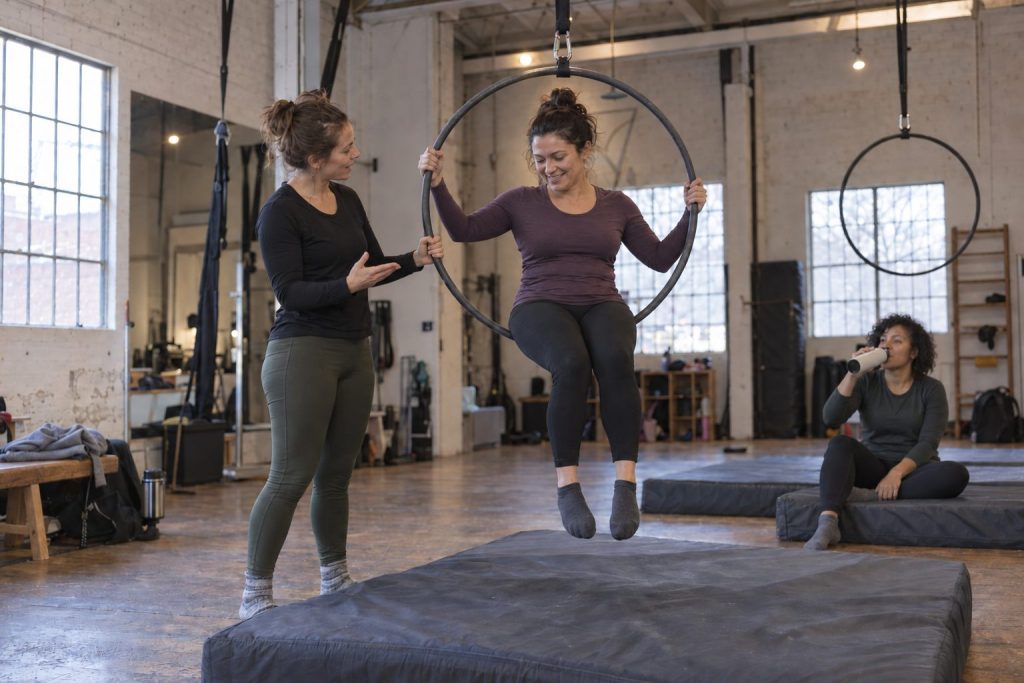
A steel hoop suspended from one or two points. On a single point it can spin freely. On two points it stays more stable. Many studios start beginners on a low hoop, close to the floor.
- Feels like: shapes and poses inside, on and under the hoop. It’s very photogenic, and hard on the backs of the knees at first.
- Suits: students who like clear shapes and building strength gradually.
- How it’s taught: mounts and seated poses on a low hoop first, with spinning and higher hoops later.
Static trapeze
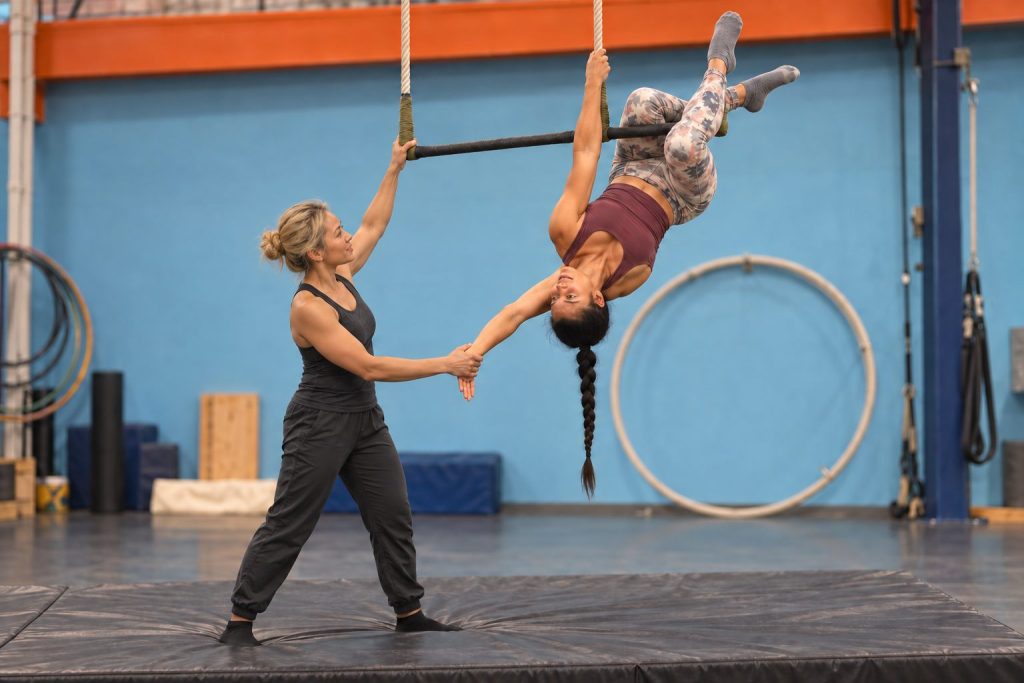
A bar hung from two ropes that stays mostly still. Students balance, hang and move between the bar and the ropes.
- Feels like: balance and body awareness as much as strength.
- Suits: beginners looking for a stable first apparatus, and students cross-training for lyra.
Flying trapeze
The classic circus act. Students swing from a high platform in a safety harness over a net, and at more advanced levels are caught by a catcher on a second trapeze.
- Feels like: pure adrenaline. Most of the challenge is trusting the process.
- Suits: thrill-seekers, and people who want to try something they’ll remember forever.
- How it’s taught: small-group sessions with a dedicated safety team, often on large or outdoor rigs.
Aerial straps
Two loops of webbing that the performer holds with their hands and wrists. Straps are known for impressive feats of strength and fast, spinning choreography.
- Feels like: very demanding on shoulders and grip.
- Suits: experienced aerialists with a solid conditioning base. Many studios teach it by invitation.
Aerial hammock, sling & aerial yoga
A single loop of fabric hung low, like a hammock. It’s used for aerial yoga, gentle inversions and supported stretching, as well as more acrobatic sling work.
- Feels like: supported and relaxing at first, and surprisingly challenging later.
- Suits: absolute beginners, yoga students and anyone nervous about heights.
Rope (corde lisse) & Spanish web
Corde lisse is a single vertical rope. It’s similar to silks but less forgiving on the skin. Spanish web is a rope with a hand or foot loop near the top, spun by a partner on the ground. It’s a classic of traditional circus.
Which apparatus should you try first?
| If you want… | Try |
|---|---|
| A gentle start | Aerial hammock or aerial yoga |
| Strength and beautiful shapes | Lyra on a low hoop |
| A full-body challenge with sequences | Aerial silks |
| A stable bar to learn on | Static trapeze |
| An unforgettable adrenaline rush | Flying trapeze |
For studio owners: scheduling several apparatus
Aerial rooms share rigging points, so the schedule has to account for what’s rigged when. A few things help:
- Set capacity to the rigs, not to a round number. A room with six points takes six students on silks, even if it could fit more on the floor.
- Group apparatus by room and time to cut down on re-rigging between classes.
- Keep separate level ladders for each apparatus. Being ready for drops on silks says nothing about spinning lyra.
- Protect advanced work such as drops, straps and open training with prerequisites or invitation-only classes.
- Collect waivers online before the first class, so nobody reaches the rig unsigned.
Running an aerial studio? See how PSM handles rigging-point capacity, drops-safe progressions and open training on the aerial studio software page.