6points
Rigging points set the limit.
A class is full when every rig is taken. PSM gives each class and room its own capacity, so a room with six points never takes an eighth booking.
Aerial arts studio software
Schedule silks, lyra, trapeze, straps and hammock classes around your rigging points. Keep drops behind the right prerequisites, collect waivers before anyone leaves the ground, and sell open training, workshops and memberships in one place.
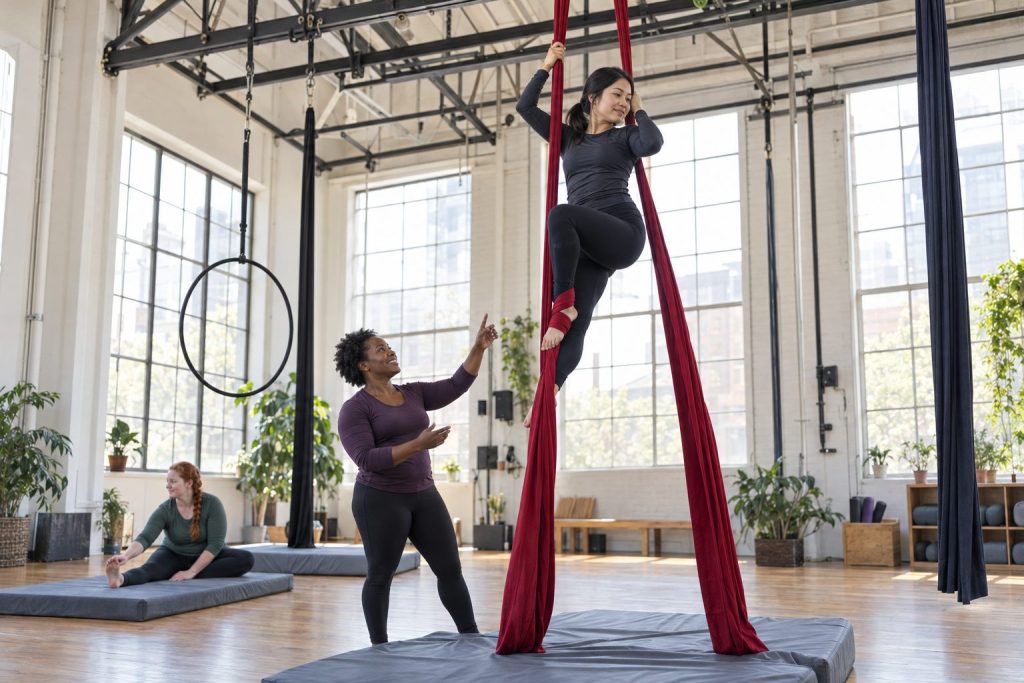
What makes an aerial studio different
A class is full when every rig is taken. PSM gives each class and room its own capacity, so a room with six points never takes an eighth booking.
Students work up from climbs and foot locks to wraps and drops. Prerequisites and invitation-only classes keep each skill in the right room.
Give each class a lead instructor and a supporting instructor, so the rota shows who teaches and who spots.
By apparatus
Some studios teach every apparatus and some specialize in one. Either way, each class gets its own level, capacity and rules.
The most common way into aerial. Programs run from climbs and foot locks to wraps and drops. In PSM: put a prerequisite between “Foundations” and “Drops”.
Class size is set by the number of hoops rigged, often at different heights. In PSM: keep low-hoop intro open and put spinning hoop behind a level.
A strong foundation for other apparatus, often taught in the same room as lyra. In PSM: share the room and capacity rules between both.
Small-group sessions on a big rig with safety lines and a catcher. In PSM: keep sessions small, and use waitlists to fill spots when someone cancels.
Strength-heavy apparatus, usually for experienced students. In PSM: make classes invitation-only or tie them to completed levels.
Low to the ground, friendly to beginners, and popular with people who already do yoga. In PSM: sell drop-ins and packs, then introduce memberships.
See it with aerial classes
Example schedule
Use your own level names and rules
The aerial studio playbook
| Offer | How studios use it | In PSM |
|---|---|---|
| Intro to aerialone-off taster | A short, low-commitment first session, often trying several apparatus. | An open class or special event with its own capacity and online checkout. |
| Multi-week courses | A 6–8 week progression works better than drop-ins for skill-heavy apparatus. | A multi-session enrollment, paid up front or in a payment plan. |
| Aerial membership | A monthly membership for regulars who train several times a week. | A recurring membership whose category decides which apparatus and levels it covers. |
| Open training | Unsupervised or lightly supervised practice for experienced students. | A members-only class, limited to students who have completed a level. |
| Privates & act creation | One-to-one coaching for performers and students preparing a showcase. | Private lessons and lesson packages. |
| Rig rental | Performers and companies rent rigging time for rehearsals. | Room bookings on the same calendar as your classes. |
| Guest workshops | Visiting artists teach intensives on a single apparatus. | A special event with limited spots and a waitlist. |
From the studio floor
Open training is only safe for students who know what they’re doing. A prerequisite on the open-training class does the checking for you.
Drops and sequences build week on week. A course keeps the same group together and gives you income up front.
When the waiver is part of online registration, nobody reaches the rig unsigned and nobody holds up the start of class.
Registration questions can ask about injuries and conditions, so instructors know before a student climbs.
Aerial studio questions
Yes. Every class has its own capacity, and rooms can be set up for each space. A silks class can have six points while a lyra class in the same room has four hoops.
Yes. Add a prerequisite to the open-training class, or make it available only to certain membership categories.
Yes. Each class can have a main instructor and supporting instructors.
Yes. Signed waivers are collected online during registration and saved to the student’s profile.
Yes. Use room bookings for rentals and rehearsals, on the same calendar as your classes.
Yes. Multiple locations are supported, at $40 a month for each additional location.
Free 30-day demo · no credit card
Get your own demo studio, pre-loaded with a sample schedule, students and memberships. Click around, try the booking rules, and see how it fits the way you run your studio.
Want a guided tour? Tick “Guided walkthrough” on the form and we’ll set up a screen-share at a time that suits you.
About a minute to fill in. We’ll email you a link to activate it.